Introduction
- The workflows presented here annotate the community-level network using existing sample annotations.
- When users have expression profiles without accompanying labels, the resulting network annotations can still provide an interpretive framework by supporting inference based on established molecular markers (for example, Verhaak subtype signatures), clinical context (for example, primary versus recurrence status), and anatomical features (for example, tumor core versus edge), leveraging communities that have already been annotated in reference cohorts.
- The scripts in this section are not intended to be fully generalizable, because sample identifiers and available annotations can differ substantially across cohorts. For example, in the GLASS cohort, sample identifiers are de-identified barcodes and must be linked to external metadata to enable annotation. In contrast, the IVYGAP dataset encodes anatomical context directly in sample names, such that certain anatomical features may be inferred without an additional metadata table.
- Accordingly, the scripts below are cohort-specific and should be adapted as needed for other datasets and naming conventions.
Directory settings
- This block defines the working directory used throughout the demo to store downloaded inputs and generated outputs.
# If you want to use a user-defined output directory,
# uncomment and set the download_dir parameter.

# download_dir <- "/path/to/download" # where soObj.RDS is located

if (exists("download_dir") && is.character(download_dir) && length(download_dir) == 1 &&
        nzchar(download_dir)) {
        download_dir <- download_dir
} else {
        download_dir <- tools::R_user_dir("sotk2", "data")
}

if (!dir.exists(download_dir)) {
        dir.create(download_dir, recursive = TRUE)
        message(download_dir, " created.")
}
Load the spatial omics object
- We load the previously generated
soObjobject, which contains the correlation network and community detection results produced in the earlier steps of the workflow. - The script first attaches the
sotk2package and then checks whethersoObj.RDSis present indownload_dir.
library(sotk2)

if (file.exists(file.path(download_dir, "soObj.RDS"))) {
        soObj <- readRDS(file.path(download_dir, "soObj.RDS"))
} else {
        stop("ERROR: the soObj.RDS file not found.")
}
Annotation colors
- This section defines a cohort-specific color map used to standardize visual annotations across figures.
- The object
pieColorsspecifies- A named color palette for IVYGAP anatomical features
- Nested palettes for GLASS sample-level metadata, including
sampleType(for example, Primary versus Recurrence) andmolecularSubtype(for example, Classical, Mesenchymal, and Proneural).
pieColors <- list(
        IVYGAP = c(
                "CT" = "red",              # cellular tumor
                "IT" = "orange",           # infiltrating tumor
                "LE" = "gold",             # tumor’s leading edge
                "MVP" = "darkslategray4",  # microvascular proliferations
                "PAN" = "burlywood4"       # palisading cells around necrosis
        ),
        GLASS = list(
                "sampleType" = c(
                        "Primary" = "chartreuse1",
                        "Recurrence" = "darkgreen"
                ),
                "molecularSubtype" = c(
                        "Classical" = "deepskyblue2",
                        "Mesenchymal" = "deeppink3",
                        "Proneural" = "coral3"
                )
        )
)
User-defined functions
- This section defines helper functions that translate cohort-specific
sample identifiers into index sets used for downstream annotation and
visualization. Because naming conventions and available metadata
differ by cohort, these utilities provide a reproducible way to map
samples to biologically meaningful groups.
.getIVYGAPidx()parses IVYGAP sample identifiers to extract abbreviated anatomical region labels (for example, CT, IT, LE, MVP, PAN) based on the encoded naming pattern, and returns indices for each region class..getGLASSidx()maps GLASS sample identifiers to phenotype categories using an external metadata table (db), returning indices for sample type (Primary versus Recurrence) and molecular subtype (Classical, Mesenchymal, Proneural).sotk2::geoMean()(exported by the package) computes the geometric mean and can be used to summarize metagene usage (or other positive-valued quantities) at the sample, community, or cohort level. This summary is often useful for comparing relative activity across communities while reducing sensitivity to extreme values. Replace exact zeros with a small pseudocount before calling (the demo uses1e-8).
.getIVYGAPidx <- function(x) {
        ctIdx <- c(); itIdx <- c(); leIdx <- c(); mvpIdx <- c(); panIdx <- c()

        if (!is.null(x)) {
                region <- stringr::str_sub(
                        sapply(stringr::str_split(x, "__"), "[[", 2), 0, 3
                )
                ctIdx <- which(region == "Cel")
                itIdx <- which(region == "Inf")
                leIdx <- which(region == "Lea")
                mvpIdx <- which(region == "Mic")
                panIdx <- which(region == "Pse")
        }

        return(list(CT = ctIdx, IT = itIdx, LE = leIdx, MVP = mvpIdx, PAN = panIdx))
}

.getGLASSidx <- function(x, db) {
        priIdx <- c(); recIdx <- c()
        claIdx <- c(); mesIdx <- c(); proIdx <- c()

        if (!is.null(x)) {
                sub <- db[which(rownames(db) %in% x), c("sample_type", "Subtype")]
                priIdx <- which(sub$sample_type == "Primary")
                recIdx <- which(sub$sample_type == "Recurrence")
                claIdx <- which(sub$Subtype == "Classical")
                mesIdx <- which(sub$Subtype == "Mesenchymal")
                proIdx <- which(sub$Subtype == "Proneural")
        }

        return(list(
                "sampleType" = list(Pri = priIdx, Rec = recIdx),
                "molecularSubtype" = list(Cla = claIdx, Mes = mesIdx, Pro = proIdx)
        ))
}

# geoMean() is provided by sotk2 (see ?sotk2::geoMean)
Community annotation
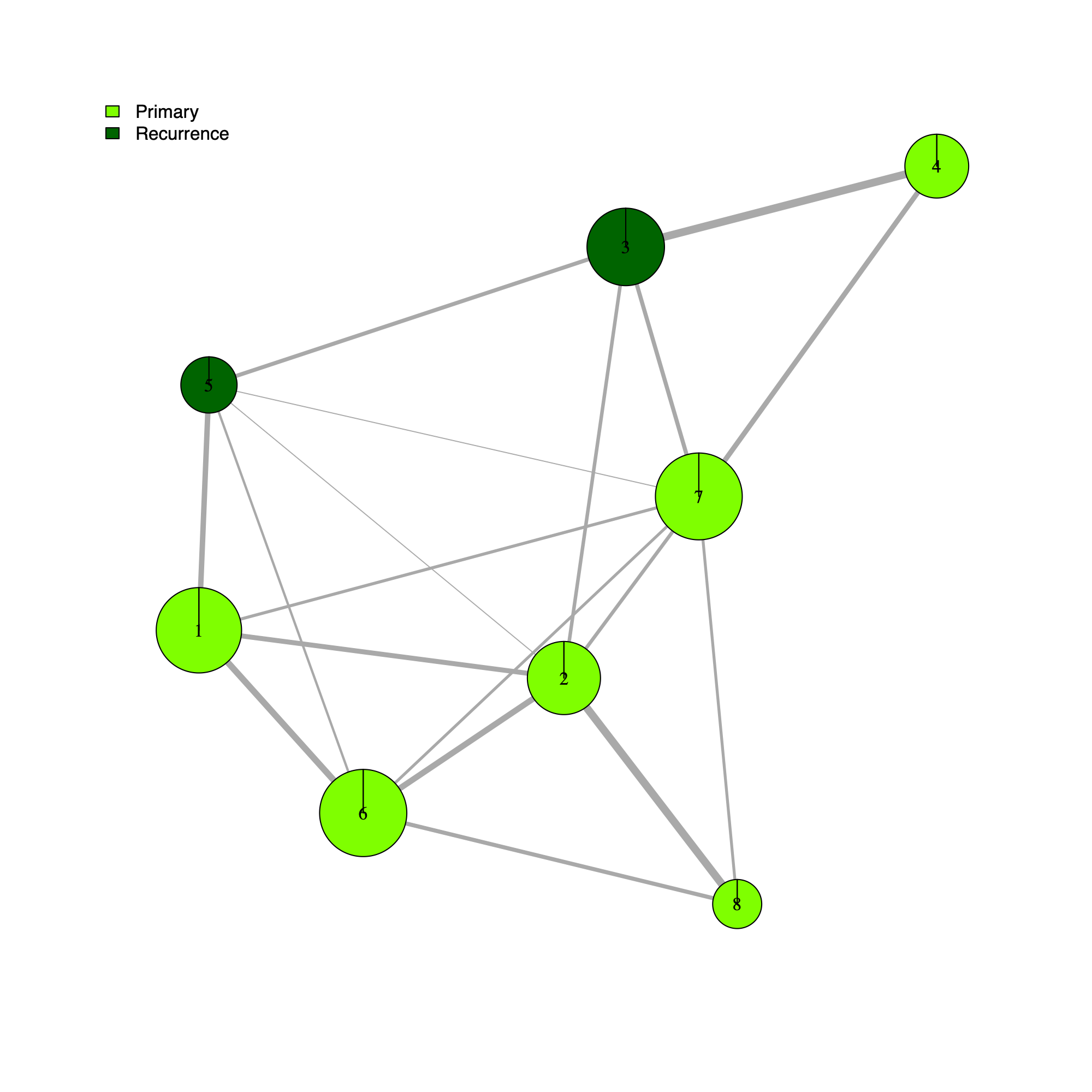
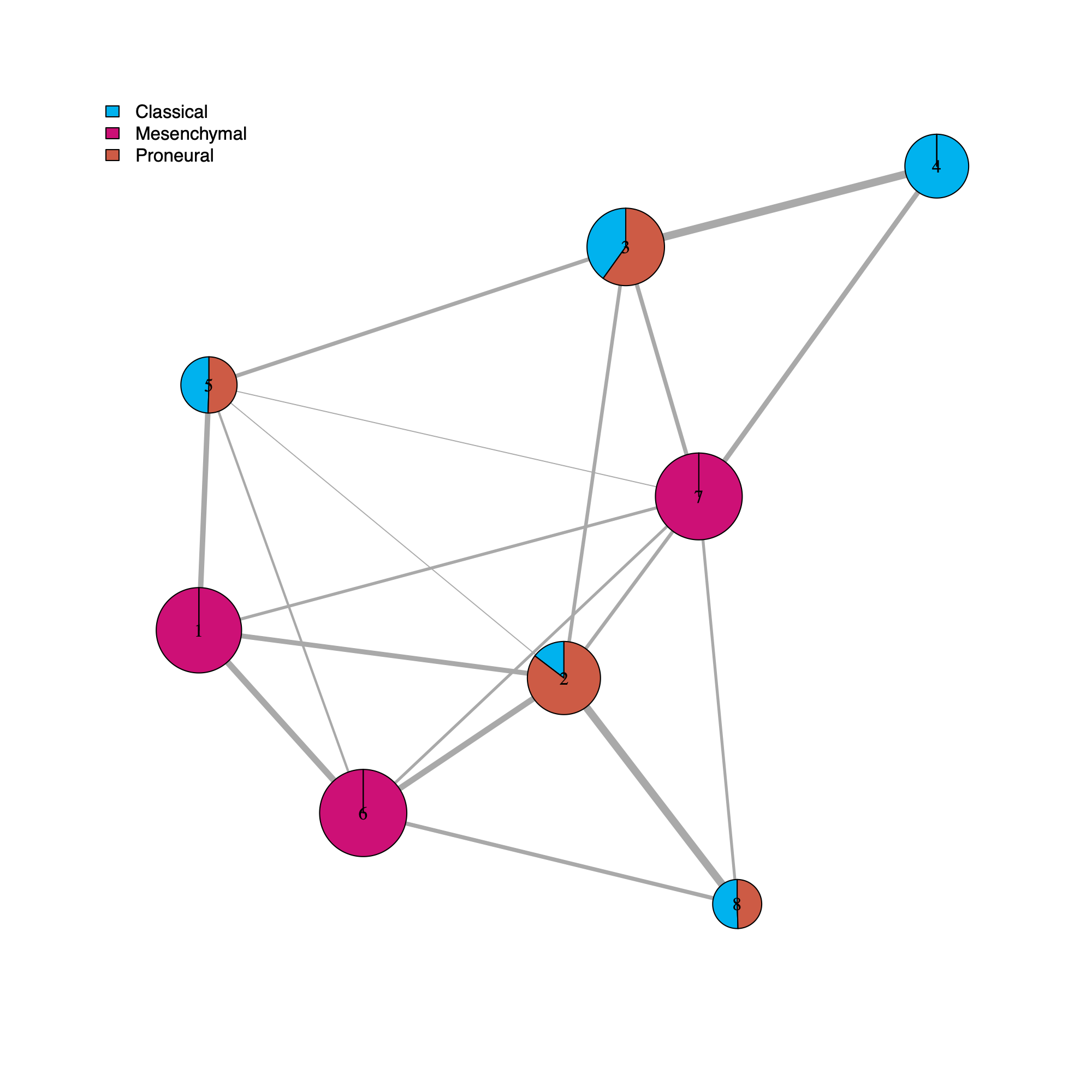
- This section annotates the community-level network using GLASS sample metadata and renders a community-level visualization in which each community node is summarized by the distribution of sample types (Primary versus Recurrence) and molecular subtypes (Classical, Mesenchymal, Proneural).
- The pie encodes positive Pearson residuals from a chi-squared test, defined as
residual = (observed - expected) / sqrt(expected).- Larger positive residuals indicate an over-representation of the category relative to the null expectation. Under-representation (negative residuals) is suppressed (set to 0) so that pie wedges always read as "enrichment" rather than "deviation."
- The magnitude of a positive residual reflects the strength of enrichment, with values further from zero providing stronger evidence that the observed frequency exceeds the expected frequency under the Chi-squared model of independence.
- If a category has zero observed counts across all communities, its residual is undefined (NA) and is treated as 0.
[GLASS] Primary vs. Recurrence
- Briefly, the code (i) extracts metagene-to-community assignments from
the correlation network, (ii) loads the GLASS annotation table
(
annot_GLASS.RDS), and (iii) aggregates, for each community, the set of samples associated with its constituent GEPs (via the GLASS metagene-to-sample mapping). - The helper function
.getGLASSidx()is then used to map those samples to metadata-defined groups, and the resulting counts are stored as a per-community "pie" vector. - Communities with non-zero counts are displayed with appropriately scaled node sizes and labels.
corNetwork <- soObj@corNetwork
clusterMembership <- soObj@sample2metagene
community <- c(1:length(soObj@commCols))
commNetwork <- soObj@commNetwork

allGEPs <- data.frame(
        Data = sapply(stringr::str_split(igraph::V(corNetwork)$name, "\\$"), "[[", 1),
        GEP = igraph::V(corNetwork)$name,
        Community = igraph::V(corNetwork)$community
)

if (file.exists(file.path(download_dir, "annot_GLASS.RDS"))) {
        glassAnnot <- readRDS(file.path(download_dir, "annot_GLASS.RDS"))
        message("annot_GLASS.RDS file imported.")
} else {
        stop("Please download annot_GLASS.RDS by running 03_download.R.")
}
## annot_GLASS.RDS file imported.
dName <- "GLASS"
legend <- names(pieColors[[dName]][["sampleType"]])
legendCol <- pieColors[[dName]][["sampleType"]]

cl <- clusterMembership[[dName]]
subGEPs <- allGEPs[which(allGEPs$Data == dName),]

# init
vertexLabel <- rep("", length(community)); names(vertexLabel) <- community
vertexSize <- rep(0.1, length(community)); names(vertexSize) <- community
vertexPie <- rep_len(list(numeric(length(legend))), length(community))
names(vertexPie) <- paste0("Community_", community)

for (whichComm in community) {
message(whichComm)
        commName <- paste0("Community_", whichComm)
        commSpecificGEPs <- subGEPs[which(subGEPs$Community == whichComm),]
        if (nrow(commSpecificGEPs) > 0) {
                allSamples <- c()
                for (gep in commSpecificGEPs$GEP) {
                        allSamples <- c(allSamples, cl[[gep]])
                }
                noSamples <- .getGLASSidx(unique(allSamples), glassAnnot)
                noSamples <- sapply(noSamples[["sampleType"]], length)

                if (sum(noSamples) != 0) {
                        vertexPie[[commName]] <- noSamples
                        vertexSize[whichComm] <- igraph::V(commNetwork)$size[whichComm]
                        vertexLabel[whichComm] <- igraph::V(commNetwork)$name[whichComm]
                }
        }
}

vertexInfo <- list(
        vertexLabel = vertexLabel,
        vertexSize = vertexSize,
        vertexPie = vertexPie,
        legend = legend,
        legendCol = legendCol
)
plotCommNetwork(soObj, vertexInfo = vertexInfo, filename = NULL)
[GLASS] Molecular subtypes
legend <- names(pieColors[[dName]][["molecularSubtype"]]) # Verhaak
legendCol <- pieColors[[dName]][["molecularSubtype"]]

# init
vertexLabel <- rep("", length(community)); names(vertexLabel) <- community
vertexSize <- rep(0.1, length(community)); names(vertexSize) <- community
vertexPie <- rep_len(list(numeric(length(legend))), length(community)); names(vertexPie) <- paste0("Community_", community)

for (whichComm in community) {
        commName <- paste0("Community_", whichComm)
        commSpecificGEPs <- subGEPs[which(subGEPs$Community == whichComm),]
        if (nrow(commSpecificGEPs) > 0) {
                allSamples <- c()
                for (gep in commSpecificGEPs$GEP) {
                        allSamples <- c(allSamples, cl[[gep]])
                }
                noSamples <- .getGLASSidx(unique(allSamples), glassAnnot)
                noSamples <- sapply(noSamples[["molecularSubtype"]], length)

                if (sum(noSamples) != 0) {
                        vertexPie[[commName]] <- noSamples
                        vertexSize[whichComm] <- igraph::V(commNetwork)$size[whichComm]
                        vertexLabel[whichComm] <- igraph::V(commNetwork)$name[whichComm]
                }
        }
}

vertexInfo <- list(vertexLabel = vertexLabel, vertexSize = vertexSize, vertexPie = vertexPie, legend = legend, legendCol = legendCol)
plotCommNetwork(soObj, vertexInfo = vertexInfo, filename = NULL)
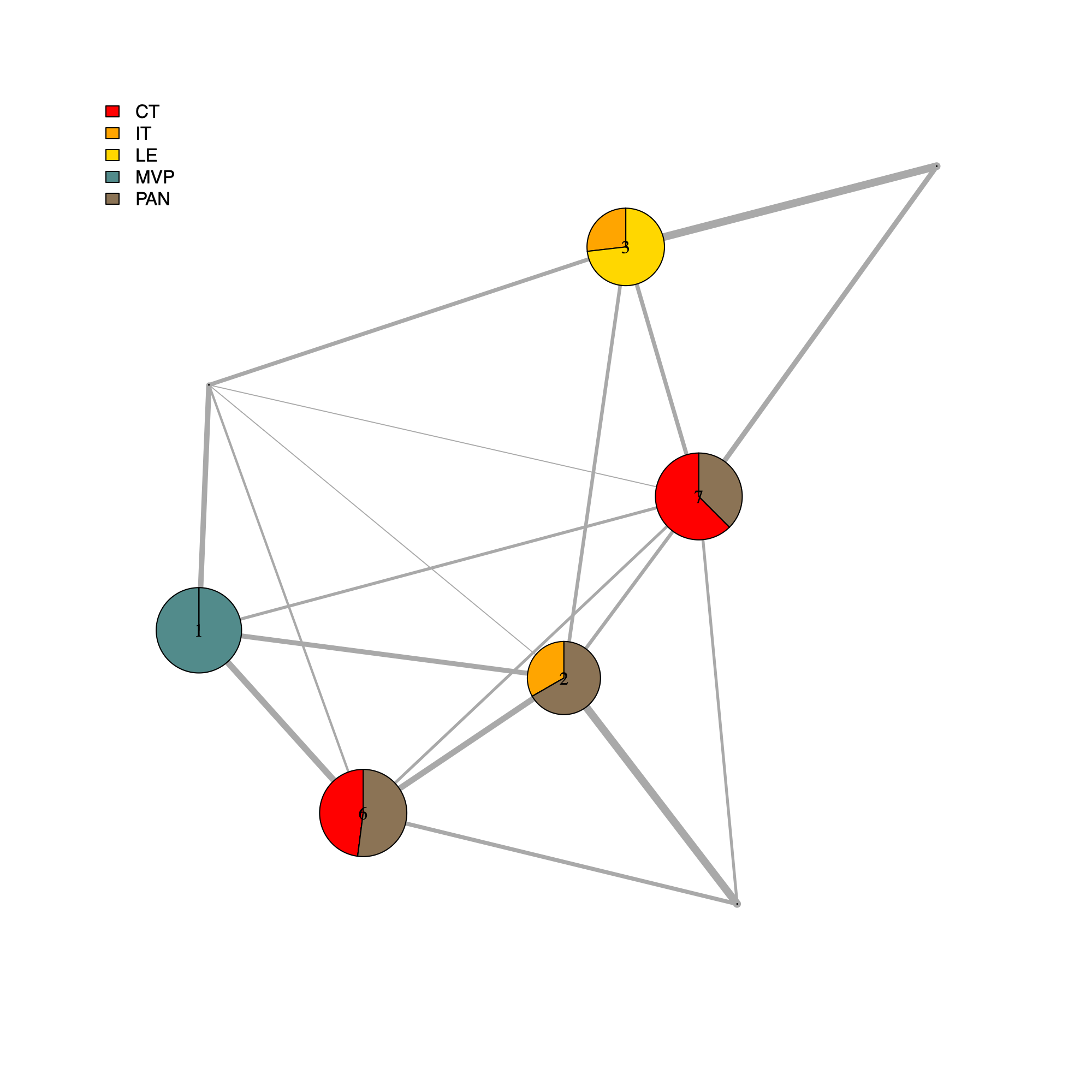
[IVYGAP] Anatomical features
- This section annotates the community-level network using IVYGAP anatomical context derived directly from sample identifiers and generates a community-level plot summarizing the anatomical composition of each community.
- For each community, the script aggregates the set of samples
associated with its constituent GEPs (via the IVYGAP
metagene-to-sample mapping) and then applies
.getIVYGAPidx()to parse sample names into anatomical region categories. - The resulting category counts are stored as a per-community "pie" vector and used to render pie-chart node annotations, with node size and labels inherited from the community network.
dName <- "IVYGAP"
legend <- c("Cellular_Tumor", "Infiltrating_Tumor", "Leading_Edge", "Microvascular_proliferation", "Pseudopalisading_cells_around_necrosis")
legendLbl <- names(pieColors[[dName]])
legendCol <- pieColors[[dName]]

cl <- clusterMembership[[dName]]
subGEPs <- allGEPs[which(allGEPs$Data == dName),]

# init
vertexLabel <- rep("", length(community)); names(vertexLabel) <- community
vertexSize <- rep(0.1, length(community)); names(vertexSize) <- community
vertexPie <- rep_len(list(numeric(length(legend))), length(community)); names(vertexPie) <- paste0("Community_", community)

for (whichComm in community) {
        commName <- paste0("Community_", whichComm)
        commSpecificGEPs <- subGEPs[which(subGEPs$Community == whichComm),]
        if (nrow(commSpecificGEPs) > 0) {
                allSamples <- c()
                for (gep in commSpecificGEPs$GEP) {
                        allSamples <- c(allSamples, cl[[gep]])
                }
                noSamples <- .getIVYGAPidx(unique(allSamples))
                noSamples <- sapply(noSamples, length)

                if (sum(noSamples) != 0) {
                        vertexPie[[commName]] <- noSamples
                        vertexSize[whichComm] <- igraph::V(commNetwork)$size[whichComm]
                        vertexLabel[whichComm] <- igraph::V(commNetwork)$name[whichComm]
                }
        }
}
vertexInfo <- list(vertexLabel = vertexLabel, vertexSize = vertexSize, vertexPie = vertexPie, legend = legend, legendLbl = legendLbl, legendCol = legendCol)
plotCommNetwork(soObj, vertexInfo = vertexInfo, filename = NULL)
Community-level NMF usages
- This section quantifies and visualizes community-level activity by summarizing metagene usage patterns derived from the cNMF results.
- For each cohort (GLASS and IVYGAP), the script iterates over inferred
communities and performs the following steps:
- Identifies the set of metagenes assigned to the current community and restricts them to the cohort of interest
- Extracts the corresponding NMF usage profiles (H/coef matrix) from the fitted NMF object
- Normalizes metagene usage across samples to obtain a comparable, compositional usage profile
- Aggregates usage across all community member metagenes by computing the geometric mean per sample.
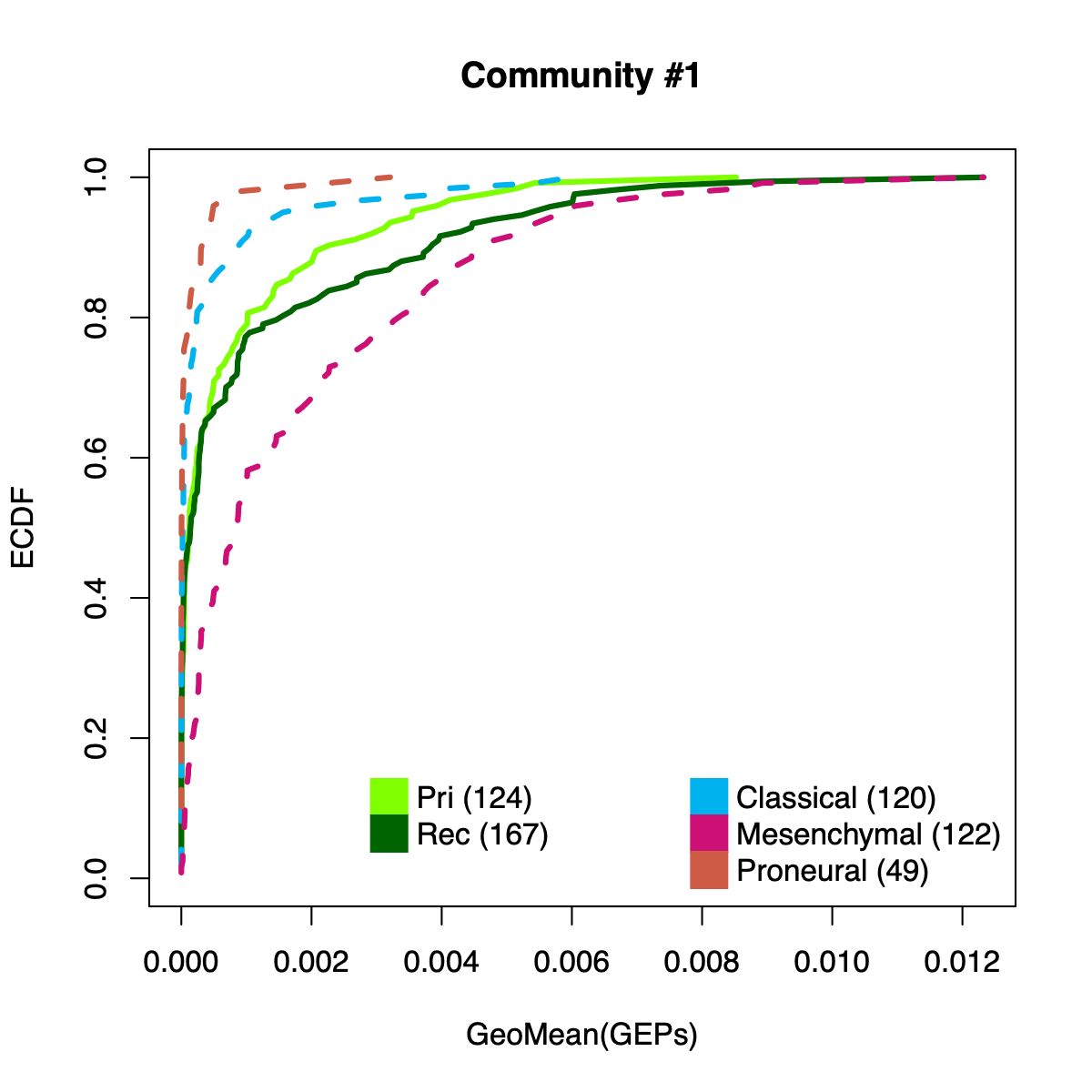
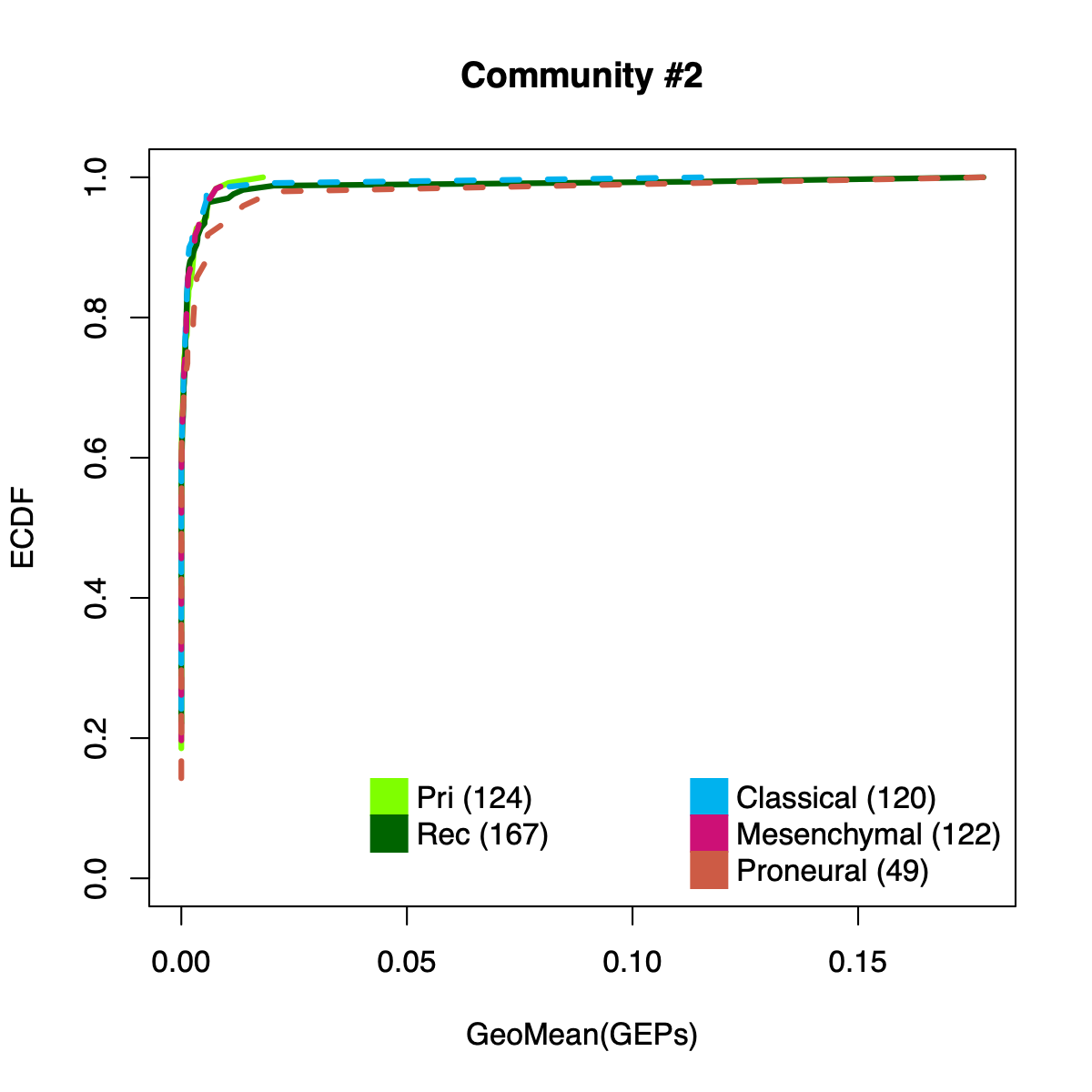
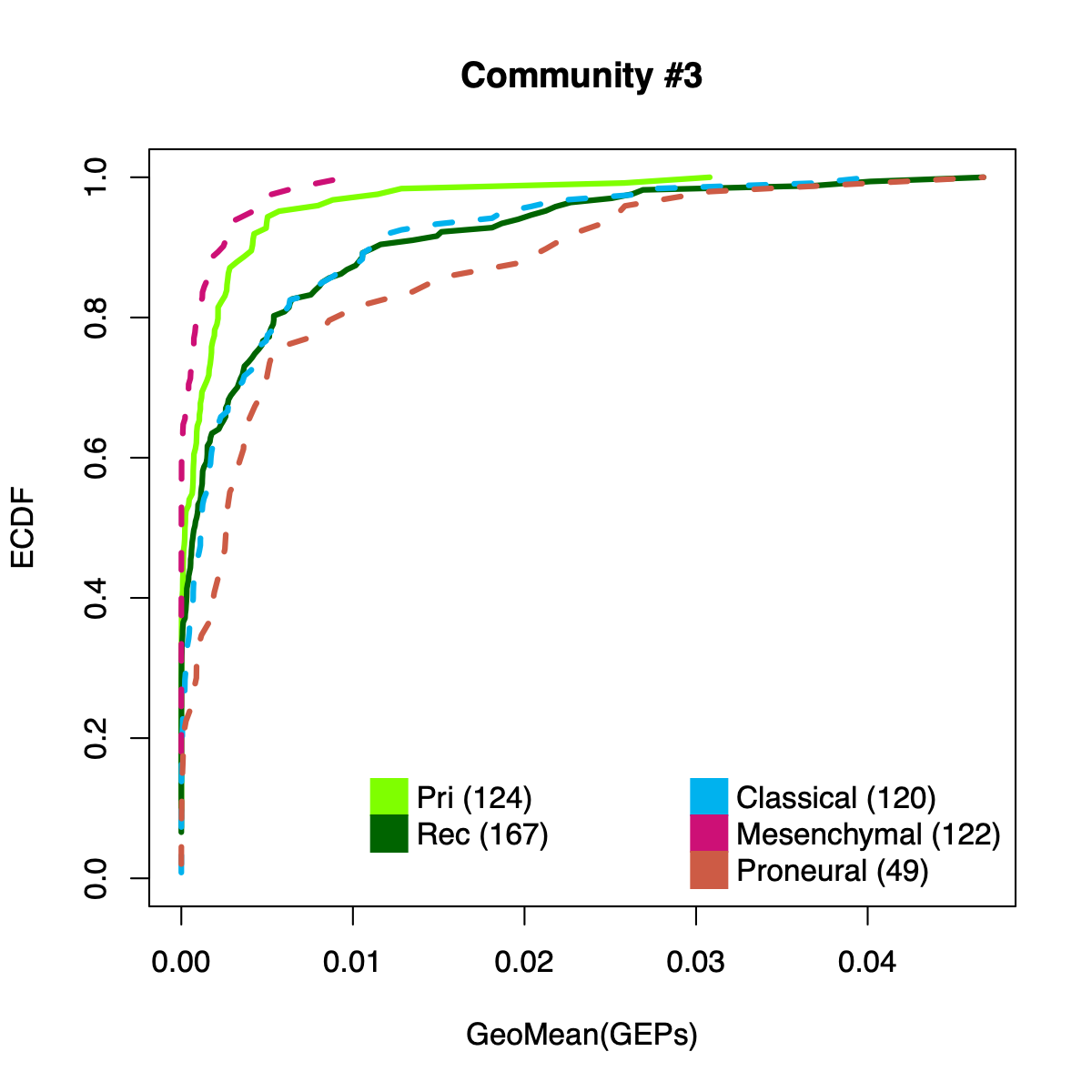
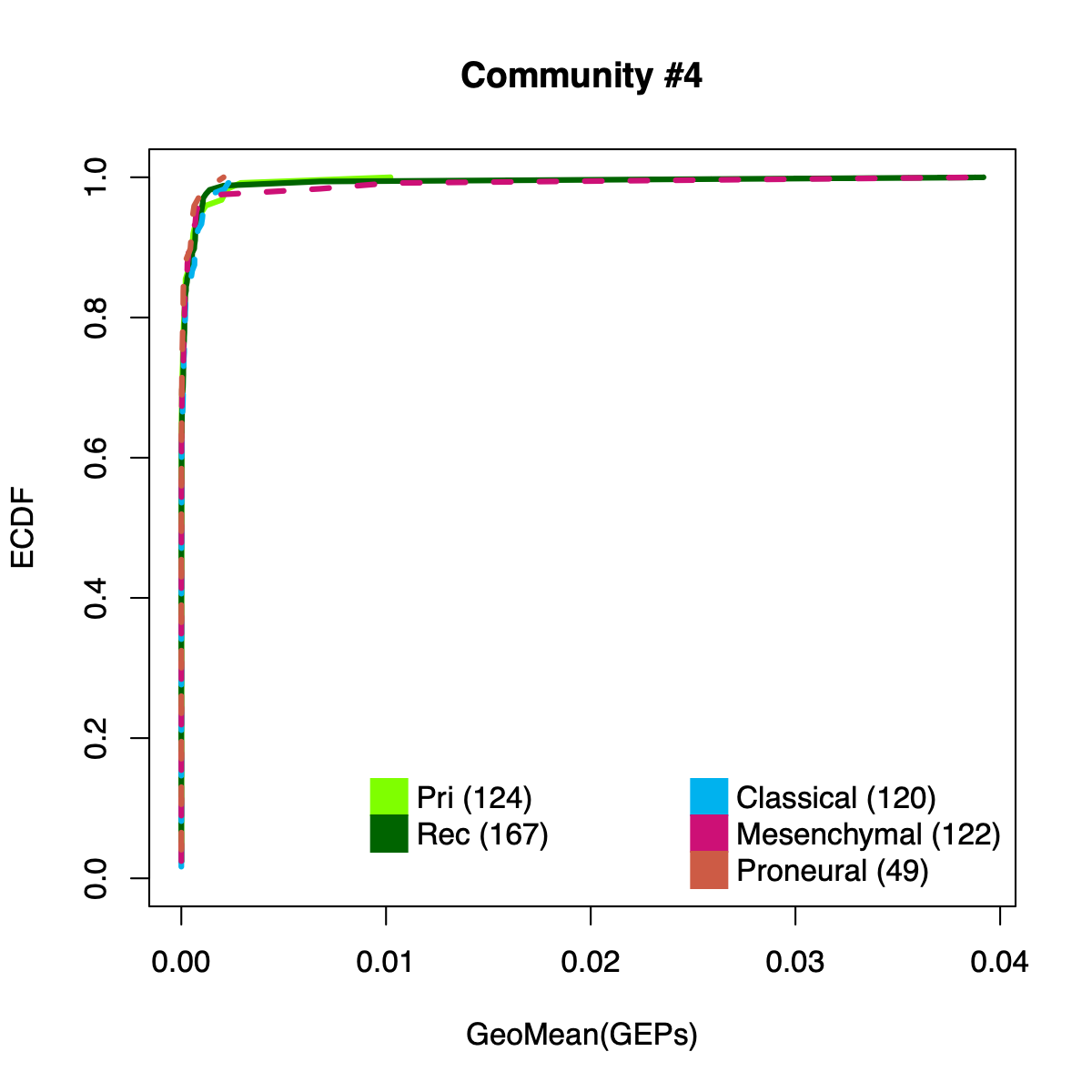
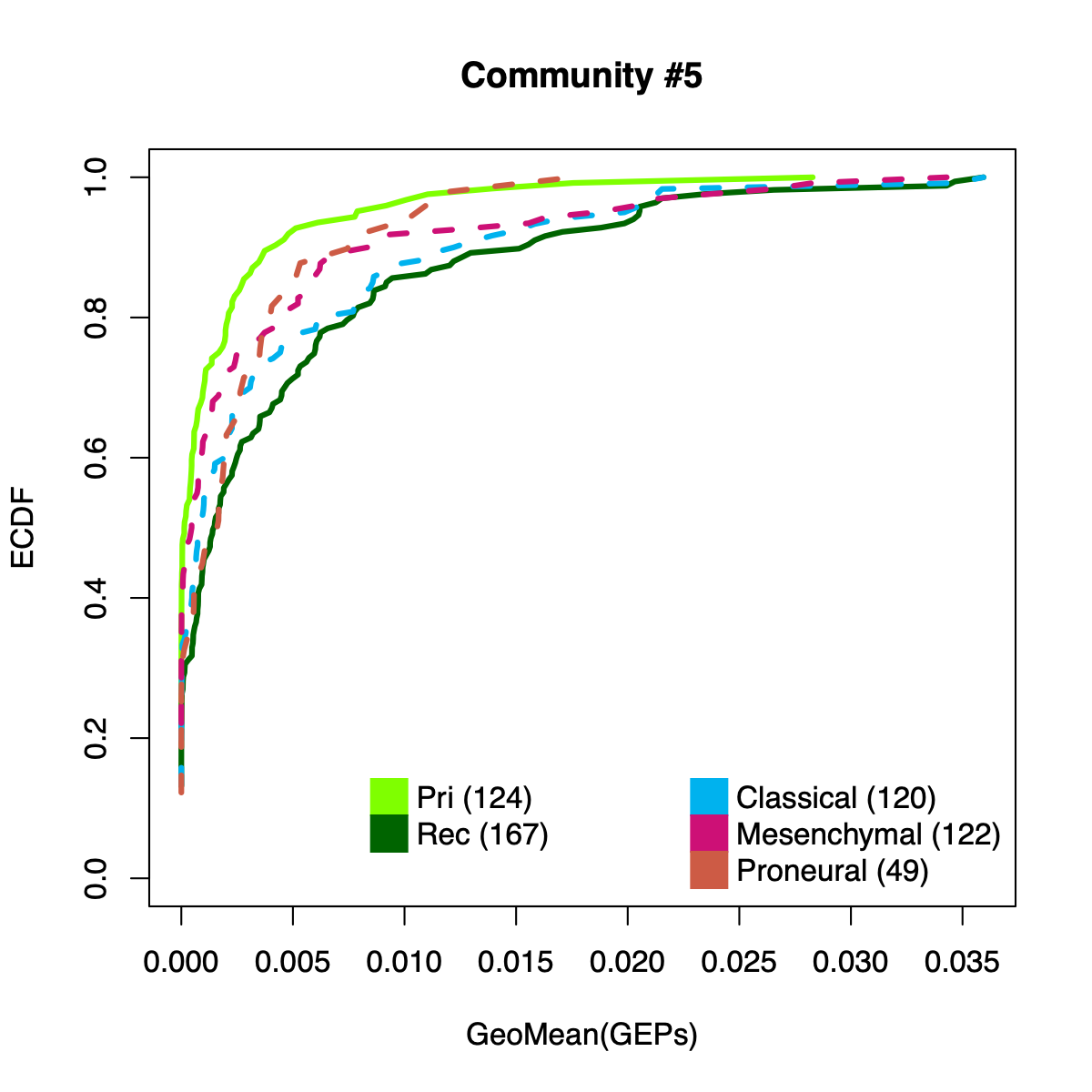
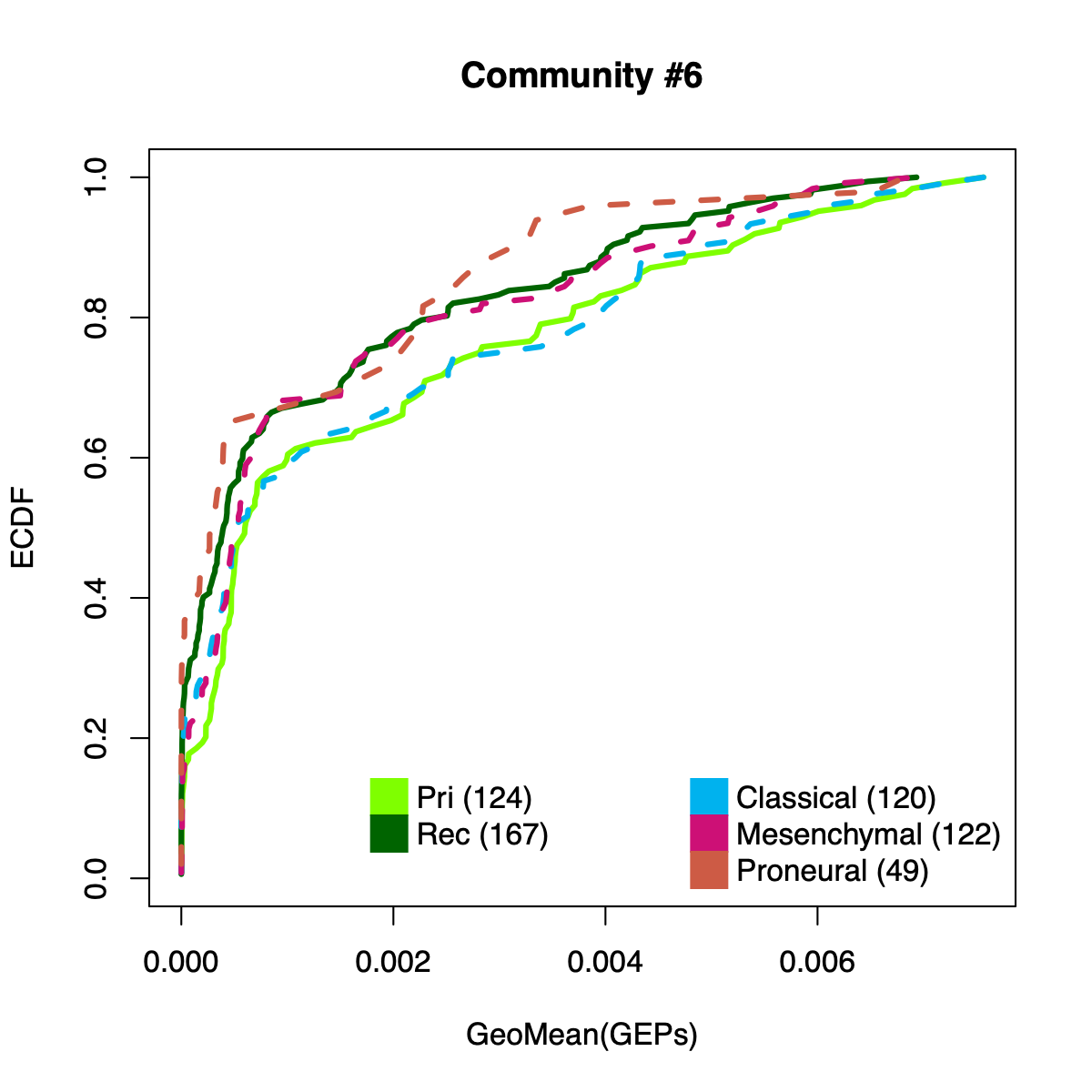
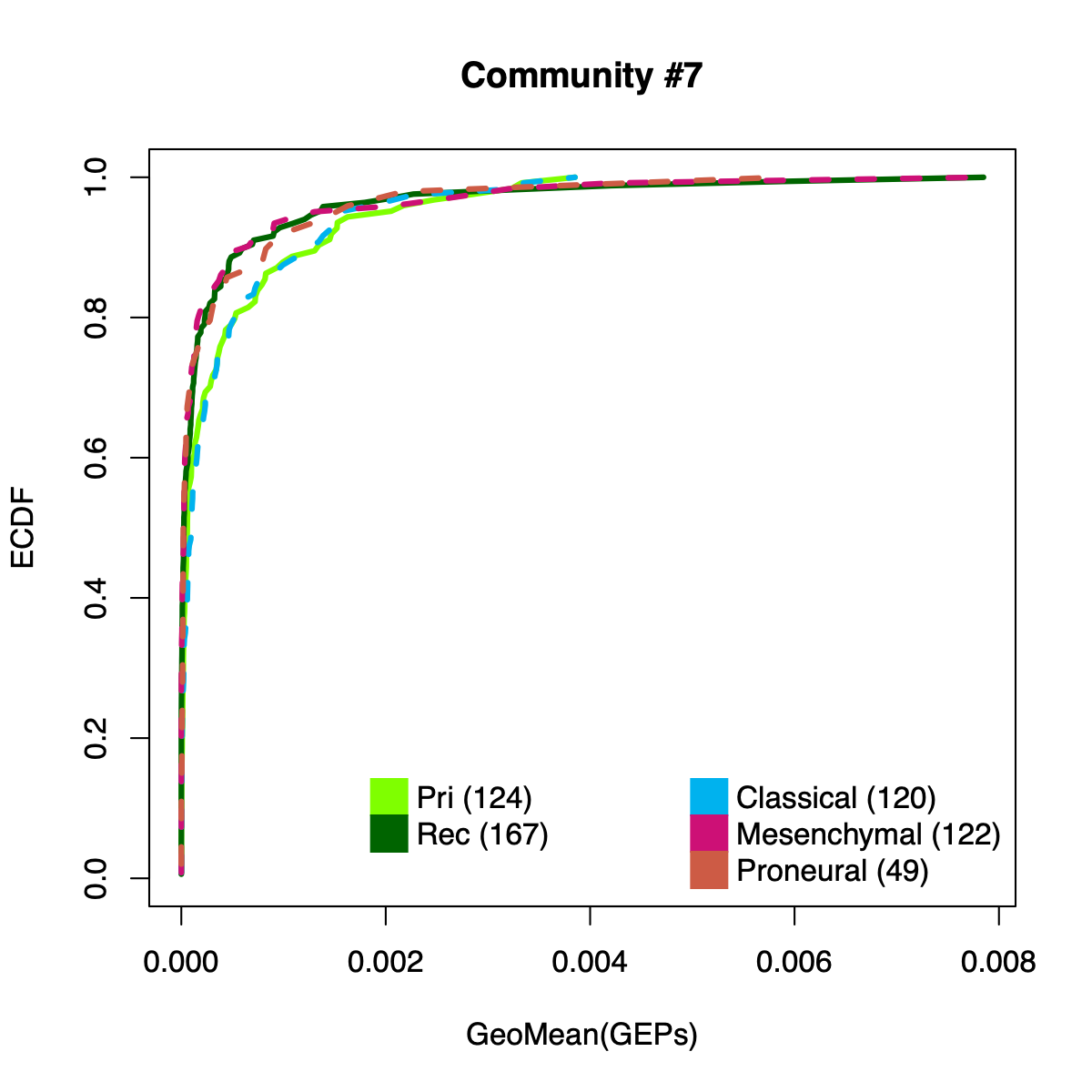
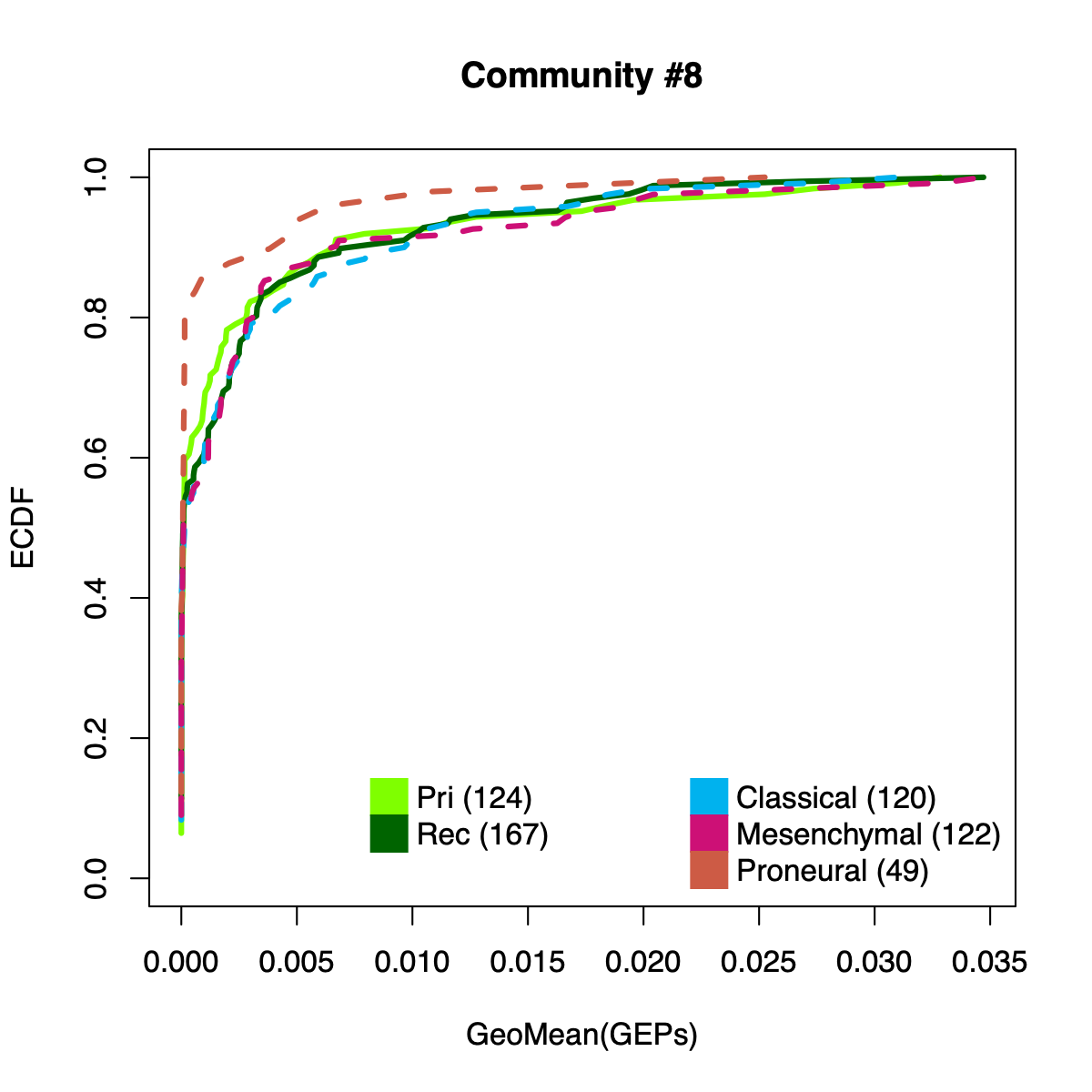
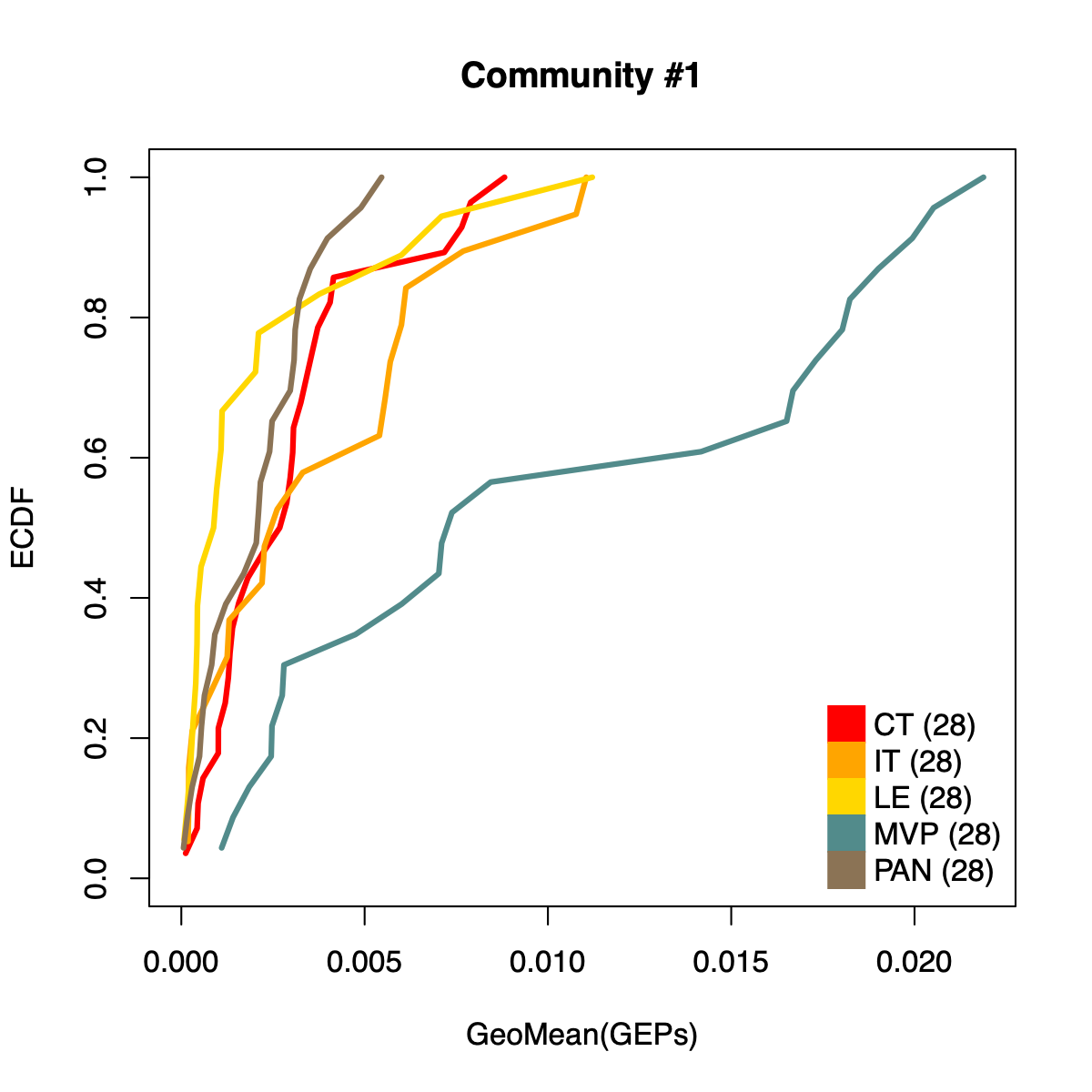
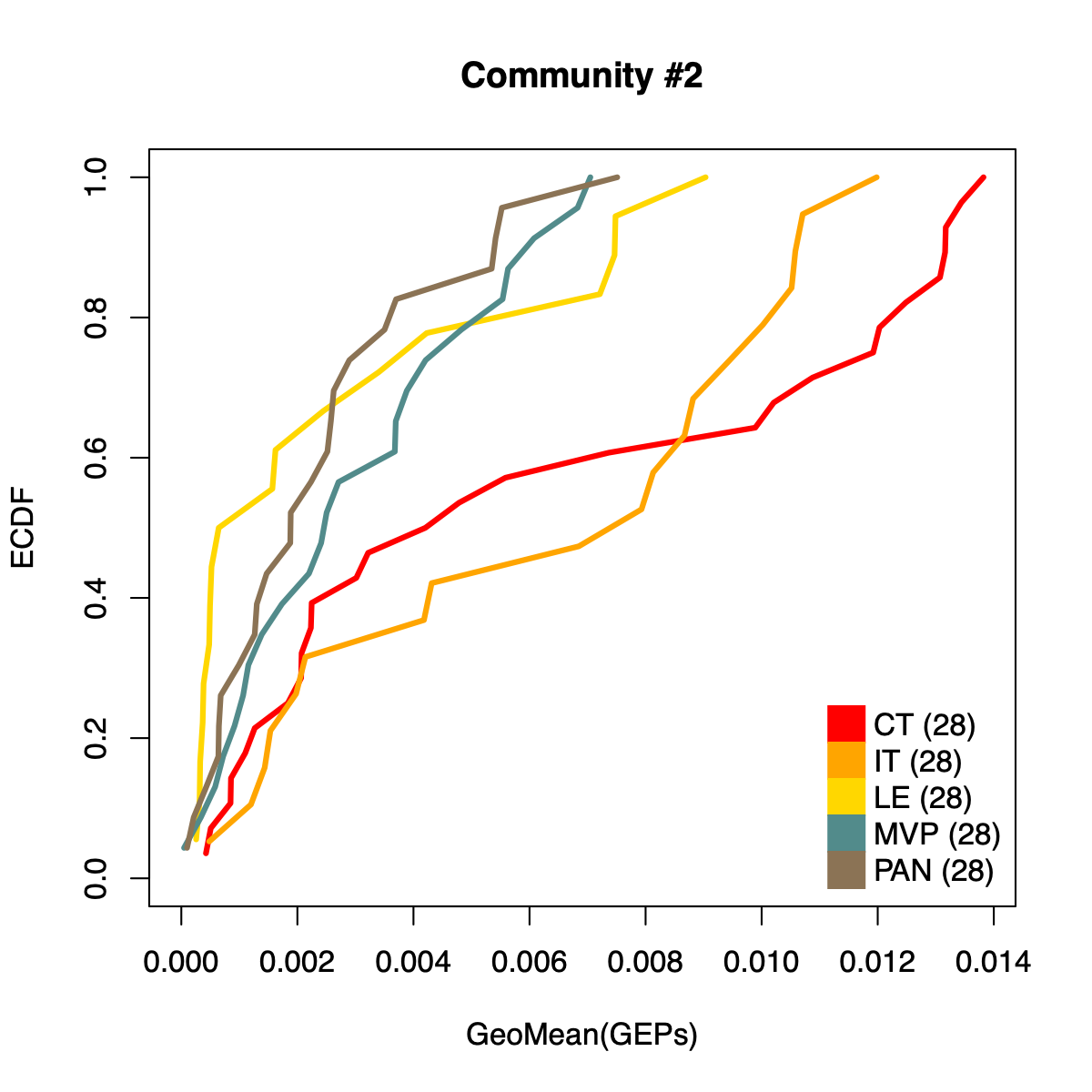
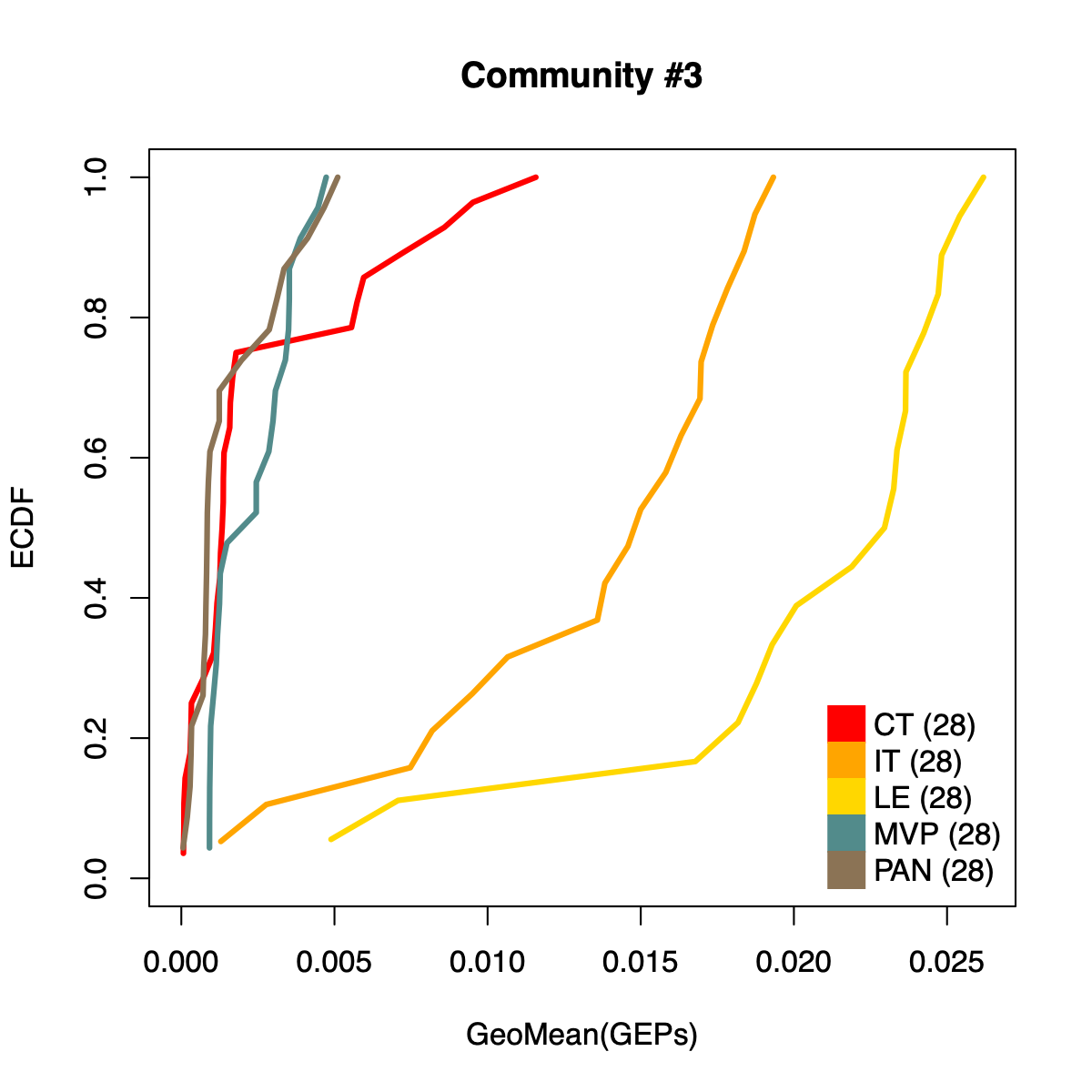
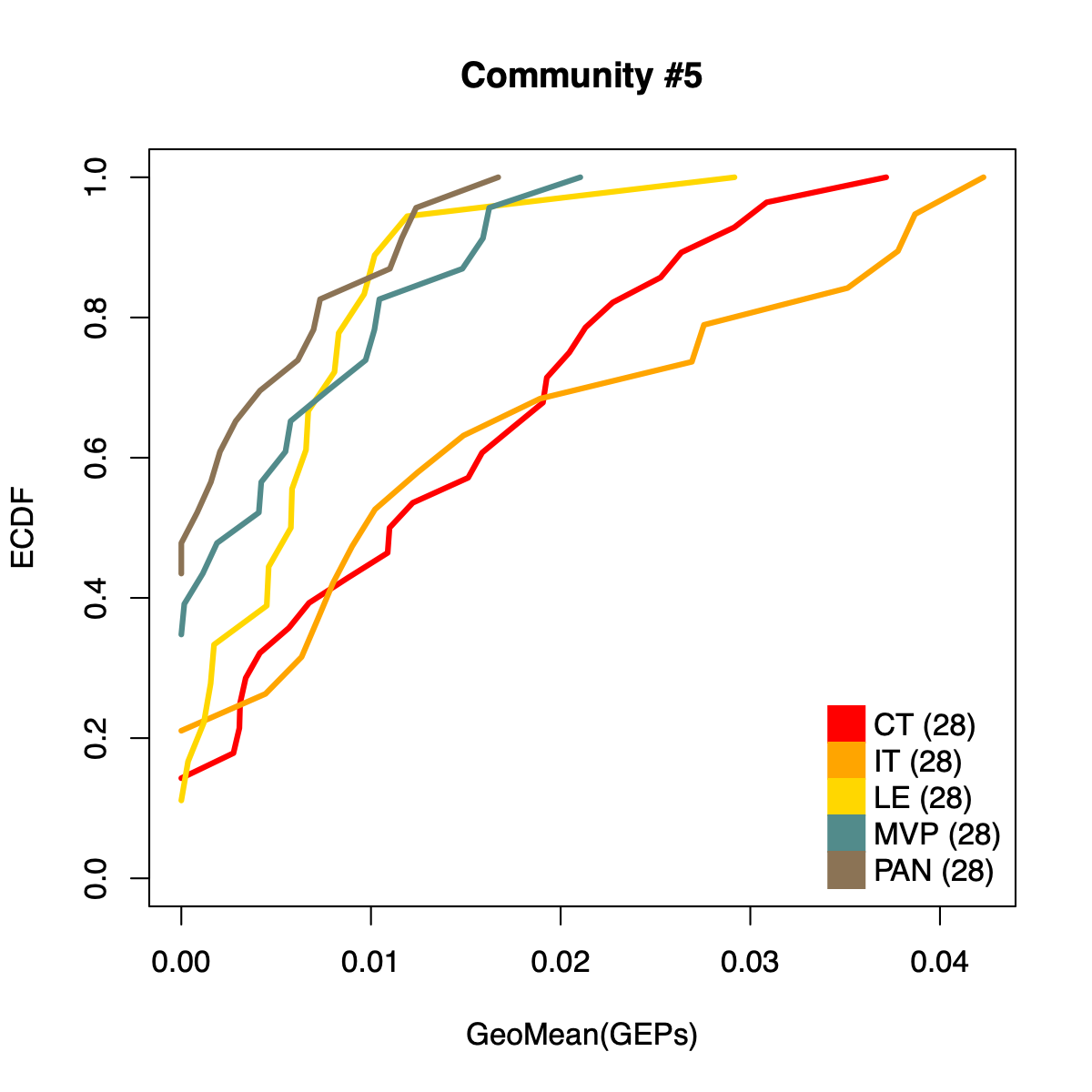
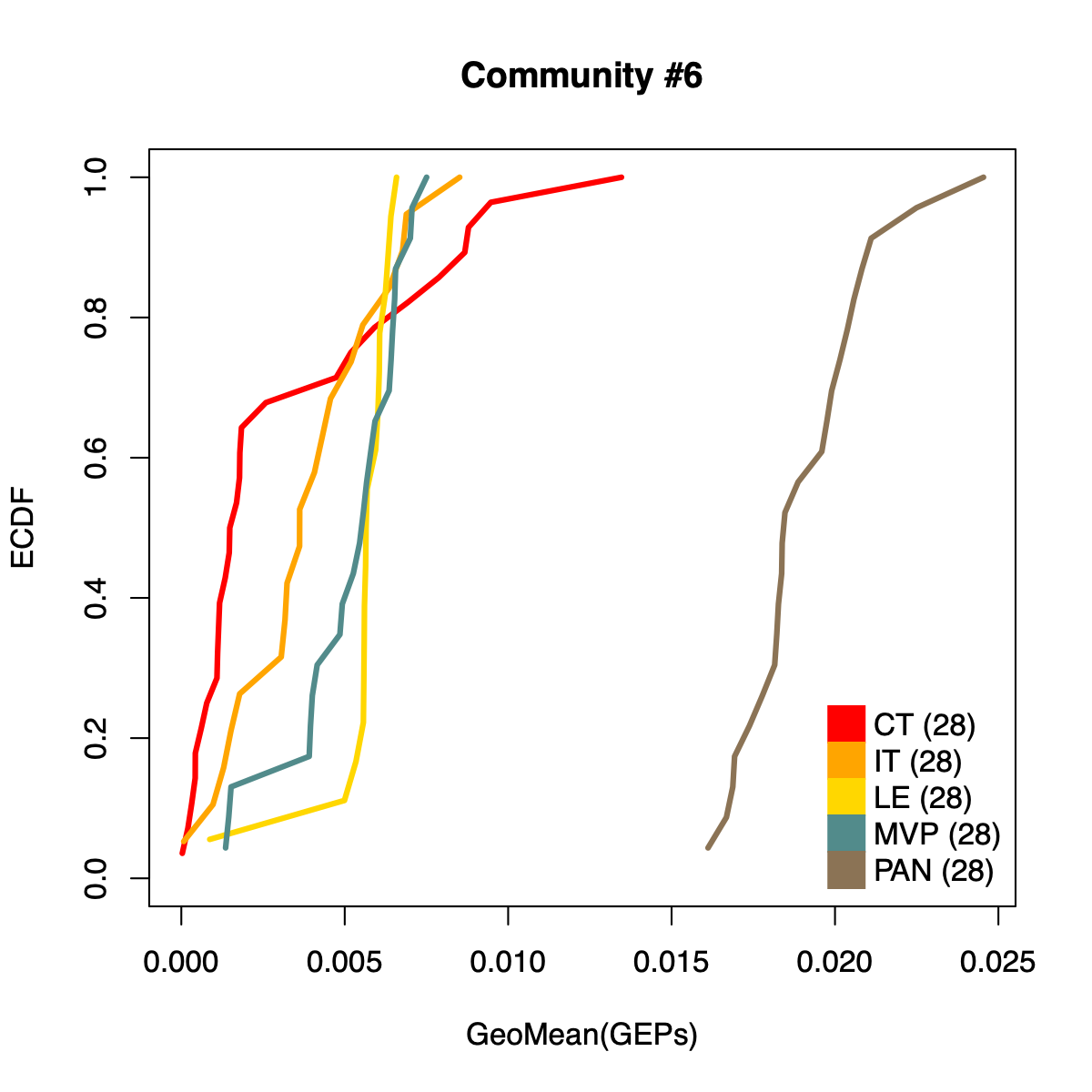
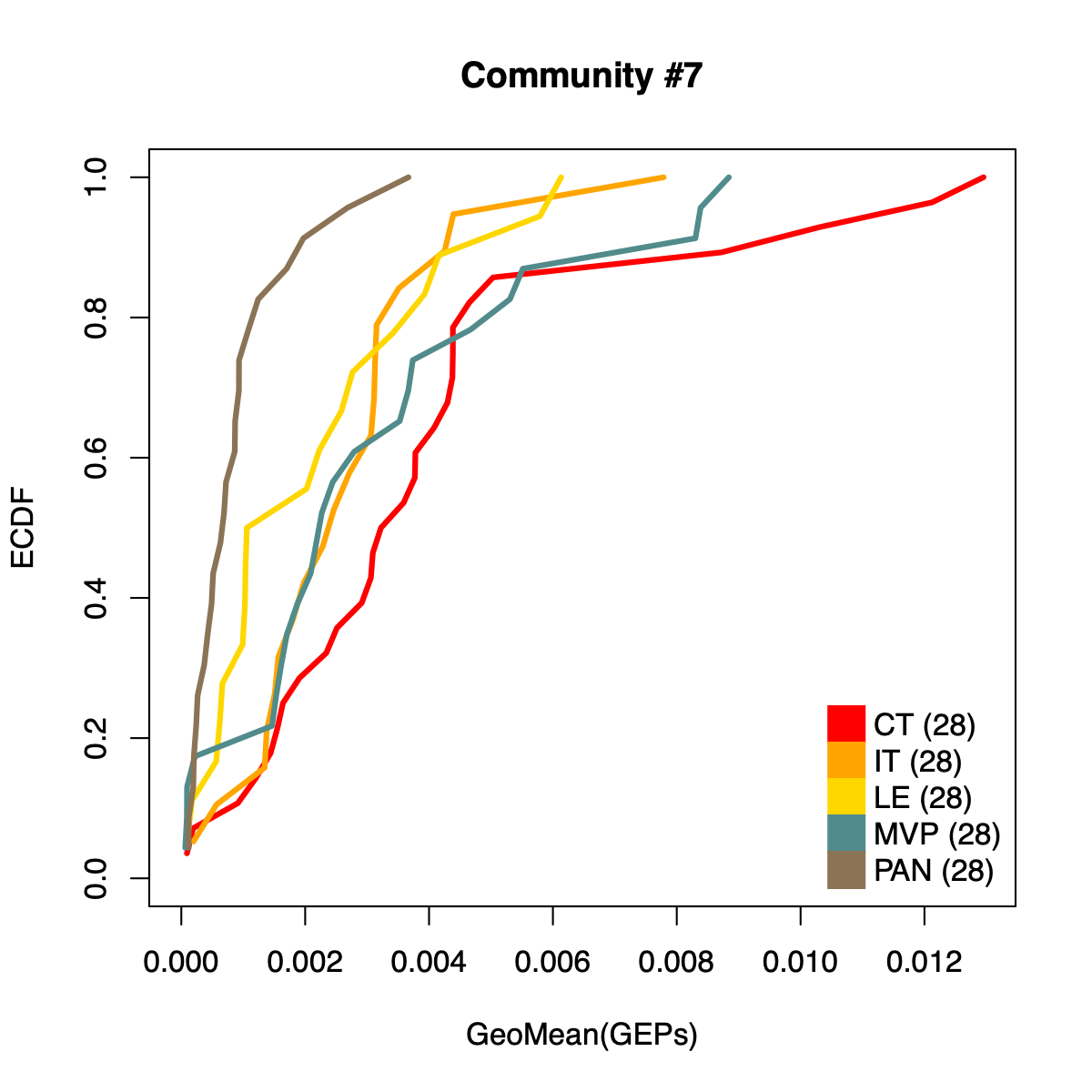
- The resulting per-sample activity estimates are then stratified by cohort-specific annotations (for example, sample type and molecular subtype in GLASS; anatomical regions in IVYGAP) and visualized using empirical cumulative distribution functions (ECDFs).
- Users can compute the geometric mean of metagene usage (from the NMF results) to identify communities with stronger or weaker activity and to reduce the risk of misinterpretation.
- The ECDF plots provide a compact comparison of community activity
distributions across annotation groups:
- They address questions such as how Community #1 and #6 differ when both appear Primary-associated based on Chi-squared residual patterns. In particular, summarizing community activity using the geometric mean of metagene usage reveals that Primary samples exhibit higher usage in Community #1, whereas Recurrence samples exhibit higher usage in Community $6. This divergence indicates that Community 1 is more plausibly interpreted as a Primary-enriched module, while Community 6 may reflect a recurrence-associated or mixed activity pattern despite similar residual-based enrichment profiles.
GLASS
glass <- readRDS(file.path(download_dir, "nmfRes_GLASS.RDS"))
ivygap <- readRDS(file.path(download_dir, "nmfRes_IVYGAP.RDS"))
dataL <- list(GLASS = glass, IVYGAP = ivygap)

dName <- "GLASS"
nmfObj <- dataL[[dName]]
nodes <- igraph::V(soObj@corNetwork)
community <- nodes$community
names(community) <- nodes$name

for (comm in c(1:length(soObj@commCols))) {
        metagenes <- names(community)[which(community == comm)]
        metagenes <- metagenes[which(
                sapply(stringr::str_split(metagenes, "\\$"), "[[", 1) == dName)]

        if (length(metagenes) > 0) {
                usageMat <- c()
                for (metagene in metagenes) {
                        buff <- unlist(stringr::str_split(metagene, "\\$"))
                        k <- as.numeric(buff[3])
                        rank <- as.numeric(buff[2])

                        usage <- NMF::coef(get(as.character(k), nmfObj$fit))

                        rowSum <- apply(usage, 1, sum)
                        nUsage <- usage/rowSum
                        usageMat <- rbind(usageMat, nUsage[rank,])
                }

                usageMat[usageMat == 0] <- 1E-08
                rep <- apply(usageMat, 2, geoMean)
                names(rep) <- colnames(usageMat)

                idx <- .getGLASSidx(names(rep), glassAnnot)

                priIdx <- idx[["sampleType"]][["Pri"]]
                recIdx <- idx[["sampleType"]][["Rec"]]
                claIdx <- idx[["molecularSubtype"]][["Cla"]]
                mesIdx <- idx[["molecularSubtype"]][["Mes"]]
                proIdx <- idx[["molecularSubtype"]][["Pro"]]

                pri <- rep[priIdx]; pri <- pri[order(pri)]; priF <- ecdf(rep[priIdx])
                rec <- rep[recIdx]; rec <- rec[order(rec)]; recF <- ecdf(rep[recIdx])
                cla <- rep[claIdx]; cla <- cla[order(cla)]; claF <- ecdf(rep[claIdx])
                mes <- rep[mesIdx]; mes <- mes[order(mes)]; mesF <- ecdf(rep[mesIdx])
                pro <- rep[proIdx]; pro <- pro[order(pro)]; proF <- ecdf(rep[proIdx])

                plot(pri, priF(pri), col="chartreuse1", xlab="GeoMean(GEPs)",
                        ylab="ECDF", main=paste0("Community #", comm),
                        type="l", lwd=3, xlim=c(0, max(rep)), ylim=c(0, 1)
                )
                lines(rec, recF(rec), col="darkgreen", lwd=3)
                lines(cla, claF(cla), col="deepskyblue2", lwd=3, lty=2)
                lines(mes, mesF(mes), col="deeppink3", lwd=3, lty=2)
                lines(pro, proF(pro), col="coral3", lwd=3, lty=2)

                legend("bottomright",
                        legend=c(
                                paste0("Pri (", length(priIdx), ")"),
                                paste0("Rec (", length(recIdx), ")"),
                                NA,
                                paste0("Classical (", length(claIdx), ")"),
                                paste0("Mesenchymal (", length(mesIdx), ")"),
                                paste0("Proneural (", length(proIdx), ")")
                        ),
                        col = c("chartreuse1", "darkgreen", NA,
                                "deepskyblue2", "deeppink3", "coral3"
                        ),
                        pch = 15, pt.cex = 2.8,
                        bty="n", ncol=2
                )
        } else {
                message(paste0("No metagenes in Community #", comm))
        }
}
IVYGAP
dName <- "IVYGAP"
nmfObj <- dataL[[dName]]
nodes <- igraph::V(soObj@corNetwork)
community <- nodes$community
names(community) <- nodes$name

for (comm in c(1:length(soObj@commCols))) {
        metagenes <- names(community)[which(community == comm)]
        metagenes <- metagenes[which(
                sapply(stringr::str_split(metagenes, "\\$"), "[[", 1) == dName)]

        if (length(metagenes) > 0) {
                usageMat <- c()
                for (metagene in metagenes) {
                        buff <- unlist(stringr::str_split(metagene, "\\$"))
                        k <- as.numeric(buff[3])
                        rank <- as.numeric(buff[2])

                        usage <- NMF::coef(get(as.character(k), nmfObj$fit))

                        rowSum <- apply(usage, 1, sum)
                        nUsage <- usage/rowSum
                        usageMat <- rbind(usageMat, nUsage[rank,])
                }

                usageMat[usageMat == 0] <- 1E-08
                rep <- apply(usageMat, 2, geoMean)
                names(rep) <- colnames(usageMat)

                idx <- .getIVYGAPidx(names(rep))
                ctIdx <- idx[["CT"]]
                itIdx <- idx[["IT"]]
                leIdx <- idx[["LE"]]
                mvpIdx <- idx[["MVP"]]
                panIdx <- idx[["PAN"]]

                ct <- rep[ctIdx]; ct <- ct[order(ct)]; ctF <- ecdf(rep[ctIdx])
                it <- rep[itIdx]; it <- it[order(it)]; itF <- ecdf(rep[itIdx])
                le <- rep[leIdx]; le <- le[order(le)]; leF <- ecdf(rep[leIdx])
                mvp <- rep[mvpIdx]; mvp <- mvp[order(mvp)]; mvpF <- ecdf(rep[mvpIdx])
                pan <- rep[panIdx]; pan <- pan[order(pan)]; panF <- ecdf(rep[panIdx])

                plot(ct, ctF(ct), col="red", xlab="GeoMean(GEPs)", ylab="ECDF",
                        main=paste0("Community #", comm),
                        type="l", lwd=3, xlim=c(0, max(rep)), ylim=c(0, 1)
                )
                lines(it, itF(it), col="orange", lwd=3)
                lines(le, leF(le), col="gold", lwd=3)
                lines(mvp, mvpF(mvp), col="darkslategray4", lwd=3)
                lines(pan, panF(pan), col="burlywood4", lwd=3)

                legend("bottomright",
                        legend=c(
                                paste0("CT (", length(ctIdx), ")"),
                                paste0("IT (", length(ctIdx), ")"),
                                paste0("LE (", length(ctIdx), ")"),
                                paste0("MVP (", length(ctIdx), ")"),
                                paste0("PAN (", length(ctIdx), ")")
                        ),
                        col = c("red", "orange", "gold", "darkslategray4", "burlywood4"),
                        pch = 15, pt.cex = 2.8,
                        bty="n", ncol=1
                )
        } else {
                message(paste0("No metagenes in Community #", comm))
        }
}
## No metagenes in Community #4
## No metagenes in Community #8
Community-assigned Visium spots
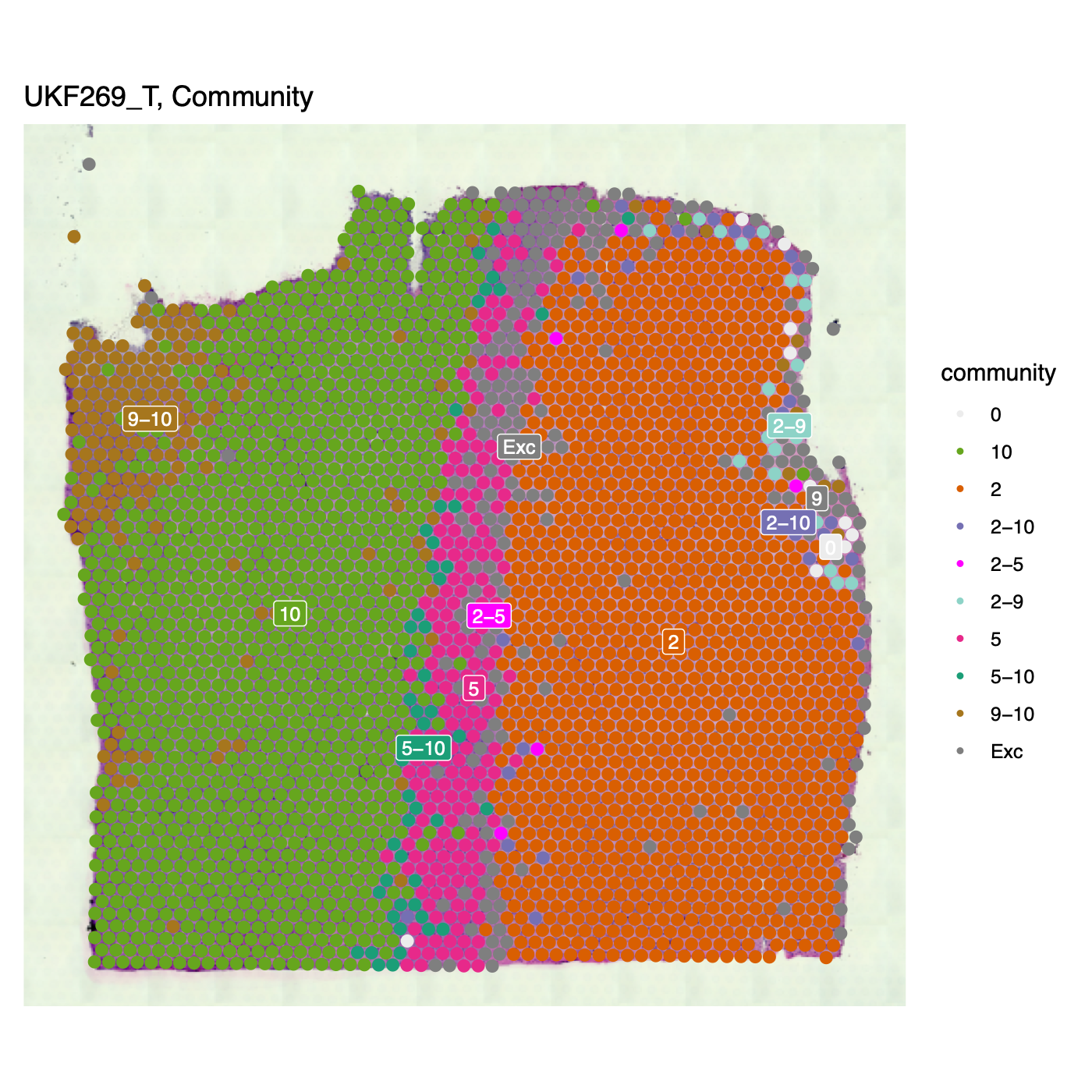
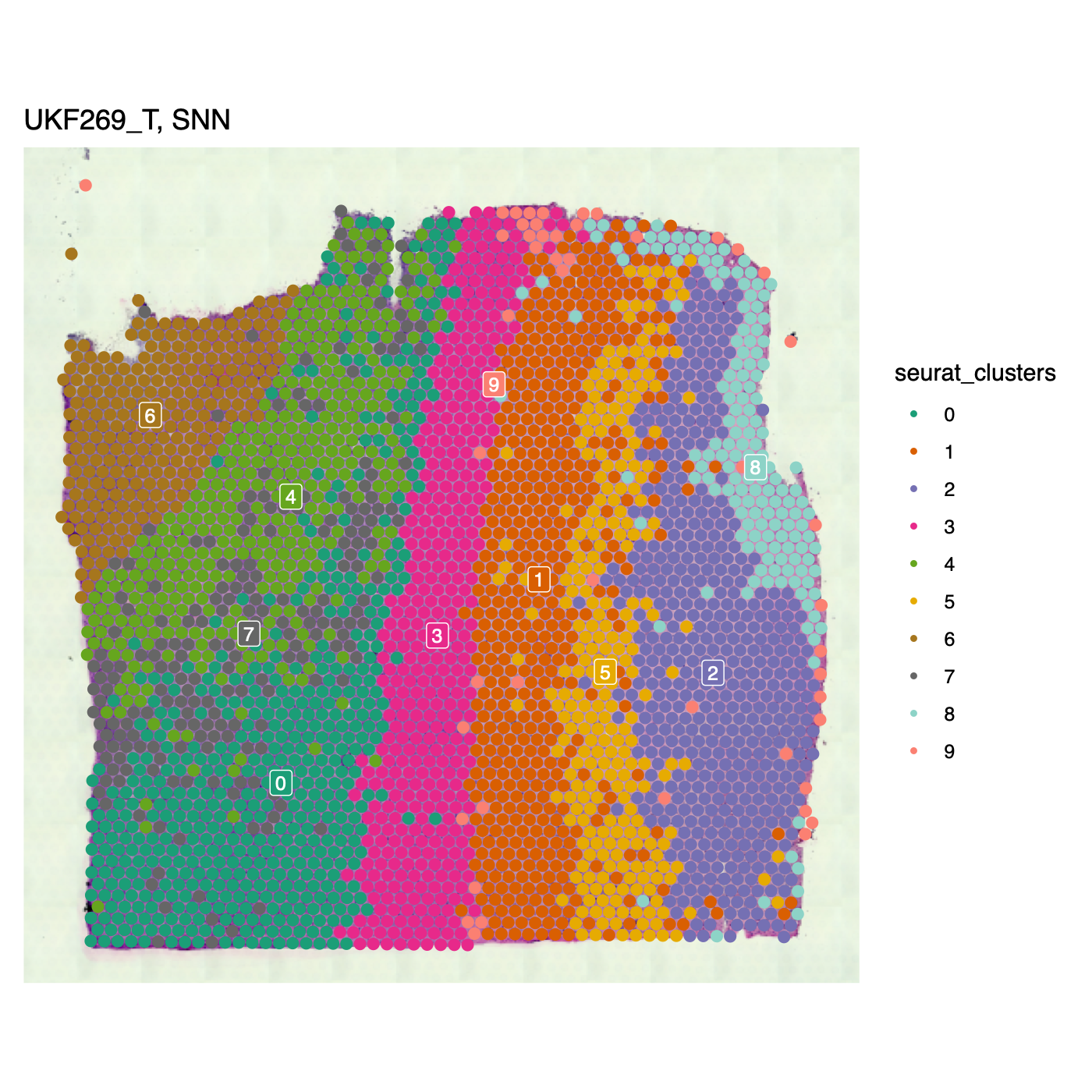
- The script below illustrates a representative visualization for a single Visium sample (
UKF269_T) and generates a two-panel figure:- Seurat SNN (shared nearest neighbor) clustering results.
sotk2community annotations, where each spot may be associated with multiple communities.
- This section requires the full demo dataset from Zenodo, including the Visium object (
UKF269_T_Visium.RDS) and the spot-level community assignments (UKF269_T_spots.RDS). - The workflow proceeds by loading and updating the Seurat object, harmonizing spot identifiers, defining color palettes for both SNN clusters and community labels, and then producing side-by-side spatial plots. Spots without community assignments are explicitly labeled as excluded (“Exc”), and spots assigned to multiple communities are summarized by concatenating community identifiers (with multi-community assignments beyond pairwise combinations collapsed into a single label for visualization).
# download_dir <- "/path/to/download" # where the demo .RDS files are located

library(Seurat)
library(stringr)
library(ggplot2)
library(gridExtra)
if (file.exists(file.path(download_dir, "UKF269_T_Visium.RDS"))) {
        seuratObj <- readRDS(file.path(download_dir, "UKF269_T_Visium.RDS"))
        seuratObj <- Seurat::UpdateSeuratObject(seuratObj)
        seuratObj <- Seurat::RenameCells(seuratObj, add.cell.id = "269_T_")
        visSpots <- readRDS(file.path(download_dir, "UKF269_T_spots.RDS")) # Community annotations
}

snnCol <- c("#1B9E77", "#D95F02", "#7570B3", "#E7298A", "#66A61E", "#E6AB02", "#A6761D", "#666666", "#8DD3C7", "#FB8072", "#80B1D3", "#FDB462", "#B3DE69")
names(snnCol) <- c("0", "1", "2", "3", "4", "5", "6", "7", "8", "9", "10", "11", "12")

commCol <- c("#A6761D", "#66A61E", "#1B9E77", "#E7298A", "magenta", "grey50", "#D95F02", "#7570B3", "#8DD3C7", "beige", "#ececec")
names(commCol) <- c("9-10", "10", "5-10", "5", "2-5", "Exc", "2", "2-10", "2-9", "2", "0")

SpatialDimPlot(
                seuratObj,
                group.by = "seurat_clusters",
                label = TRUE, label.size = 3,
                pt.size.factor = 250) +
        theme(legend.position = "right") +
        labs(title = "UKF269_T, SNN") +
        scale_fill_manual(values = snnCol[levels(seuratObj@meta.data$seurat_clusters)])
excluded <- c(); community <- c()
for (spotName in rownames(seuratObj@meta.data)) {
        if (spotName %in% names(visSpots)) {
                comm <- paste(sort(unlist(visSpots[spotName])), collapse="-")
                if (str_count(comm, "-") > 1) comm <- 0
        } else {
                comm <- "Exc"
                excluded <- c(excluded, spotName)
        }
        community <- c(community, comm)
}

community <- factor(community)
seuratObj@meta.data$community <- community

SpatialDimPlot(seuratObj,
                group.by = "community",
                label = TRUE, label.size = 3,
                pt.size.factor = 250) +
        theme(legend.position = "right") +
        labs(title = "UKF269_T, Community") +
        scale_fill_manual(values = commCol[levels(community)])